
自然素材の塗る文化から、近代の洋式ペイントへ

前回は、縄文の漆から始まる「塗る文化」について見てきました。
漆。ベンガラ。朱。膠。米糊。布海苔。柿渋。
合成樹脂塗料が生まれるはるか前から、人は自然の中にある「くっつくもの」「固まるもの」「色が出るもの」「水に強くなるもの」を見つけ、暮らしの中で使いこなしてきました。
それは、生活の道具を守るための技術であり、美しく飾るための文化でもありました。
しかし、時代が大きく動きます。
江戸時代の終わり、日本に黒船が来航します。
そして開国とともに、海外から新しい建築、新しい文化、新しい材料が入ってきます。
その中の一つが、ペンキと呼ばれる洋式の塗装材料でした。
黒船来航と、洋式ペイントのはじまり
自然素材の塗る文化から、近代の洋式ペイントへ
幕末、日本は大きな転換期を迎えます。
1853年、マシュー・ペリー率いる黒船が来航しました。
その後、1858年には日米修好通商条約が結ばれ、横浜をはじめとする開港地には外国領事館や洋風建築が置かれるようになります。
この開国の流れの中で、日本に本格的に入ってきたものの一つが、西洋式の塗装でした。
横浜市神奈川区にある本覚寺は、開港期にアメリカ領事館として使われた寺院です。
本覚寺の公式資料では、当時の領事館員たちが、当時の日本には存在していなかった西洋塗装法、いわゆるペンキによって、建物の彫刻などを塗装したと紹介されています。
つまり、日本の近代的なペンキ塗装は、開国と外国領事館、そして横浜の洋風文化と深く関係していたのです。
それまでの日本には、漆、柿渋、膠、天然顔料などによる「塗る文化」がありました。
しかし、西洋建築や外国人居留地に使われるペンキは、日本にとって新しい塗装技術でした。
木を漆で仕上げる文化から、洋館や領事館をペンキで塗る文化へ。
ここで、日本の塗る技術は大きな転換点を迎えます。

洋式ペイントとは何だったのか
当時の洋式ペイントは、現代の水性塗料や合成樹脂塗料とは違います。
基本になるのは、油と顔料です。
現代の言葉でいうと、油がバインダーや展色材のような役割を持ち、顔料が色を与える役割を持ちます。
特に、顔料を油とともに硬めに練ったものは、堅練り塗料と呼ばれます。
これは、現代のように缶を開けてそのまま塗れる調合済み塗料とは少し違います。
顔料と油を高濃度で練った材料を、使用時に油などで調整しながら塗るようなイメージです。
前回の自然素材の時代では、漆が天然の樹脂、ベンガラや朱が顔料のような役割を持っていました。
今回の洋式ペイントでは、油が展色材やバインダーの役割を持ち、顔料が色を与える材料になります。
材料は変わっても、基本には同じ考え方があります。
色を出すもの。それを固着させるもの。表面を守るもの。美しく見せるもの。
この組み合わせが、塗料の基本なのです。
なぜ洋式ペイントが必要になったのか
では、なぜ日本に洋式ペイントが必要になったのでしょうか。
それは、社会そのものが変わったからです。
開国によって、西洋風の建築が入ってきました。外国人居留地がつくられました。洋館が建てられました。鉄道、船舶、橋梁、工場、軍事施設など、近代的なインフラが整備されていきました。
これまでの日本の伝統的な木造建築や工芸品だけでなく、西洋式の建物や鉄の構造物を守る必要が出てきたのです。
特に重要だったのが、船舶や鉄製品です。
木を守るだけでなく、鉄を錆から守る。建物を美しくするだけでなく、近代化する社会インフラを長持ちさせる。
ここで、塗料の役割は大きく変わります。
塗料は、単なる色や装飾ではなく、近代産業を支える材料になっていったのです。

輸入ペンキから、国産ペンキへ
最初、日本の洋式ペイントは輸入に頼っていました。
海外から入ってきたペンキを使い、洋館や船舶、近代建築に塗装していきます。
しかし、近代化が進むほど、塗料の需要は増えていきます。
洋館が増える。船が増える。鉄道が伸びる。橋が架かる。工場が建つ。
そうなると、いつまでも輸入に頼るわけにはいきません。
日本でも、洋式塗料を自分たちで作る必要が出てきます。
そこで登場するのが、茂木重次郎です。
日本化学会の化学遺産資料「近代日本における塗料工業の発祥」では、茂木重次郎が1878年に亜鉛華の製法を確立し、1879年には洋式塗料である堅練り塗料の国産化に日本で初めて成功したと紹介されています。
そして1881年、日本ペイントの前身である光明社が設立されます。
ここから、日本の近代塗料工業が本格的に始まります。

亜鉛華と、白い顔料の重要性
近代塗料の国産化を考えるうえで、亜鉛華は重要な存在です。
亜鉛華とは、酸化亜鉛を主成分とする白色顔料です。
白い塗料を作るには、白い顔料が必要です。
また、当時は白粉などに使われた鉛による中毒問題もあり、亜鉛華は白色材料として重要な意味を持っていました。
つまり、塗料の国産化は、単に「色を作る」話ではありません。
顔料を作る技術。油と混ぜる技術。練る技術。安定した品質で製造する技術。社会に必要な材料を供給する技術。
これらが一体となって、近代塗料工業が形づくられていきました。
前回のブログで見たベンガラや朱は、自然の中から取り出した天然顔料でした。
一方、近代塗料では、顔料を工業的に作り、安定して供給することが重要になります。
ここにも、大きな時代の変化があります。
自然から見つける顔料から、工業的に作る顔料へ。
これは、塗料の歴史における大きな進歩でした。

日本初の国産洋式塗料と光明社
1881年に設立された光明社は、日本の近代塗料工業の出発点とされています。
光明社は、現在の日本ペイントホールディングスにつながる会社です。
日本化学会の第6回化学遺産認定でも、「日本には古くから漆塗りや柿渋に代表される塗料はあったが、現在我々が『塗料』と呼んでいるもののほとんどは明治時代以降の洋式塗料である」と整理されています。
つまり、日本の塗料の歴史には二つの流れがあります。
一つは、漆や天然顔料による伝統的な塗る文化。
もう一つは、明治以降に始まる洋式塗料と近代塗料工業の流れです。
この二つが重なりながら、日本の塗料技術は発展していきました。

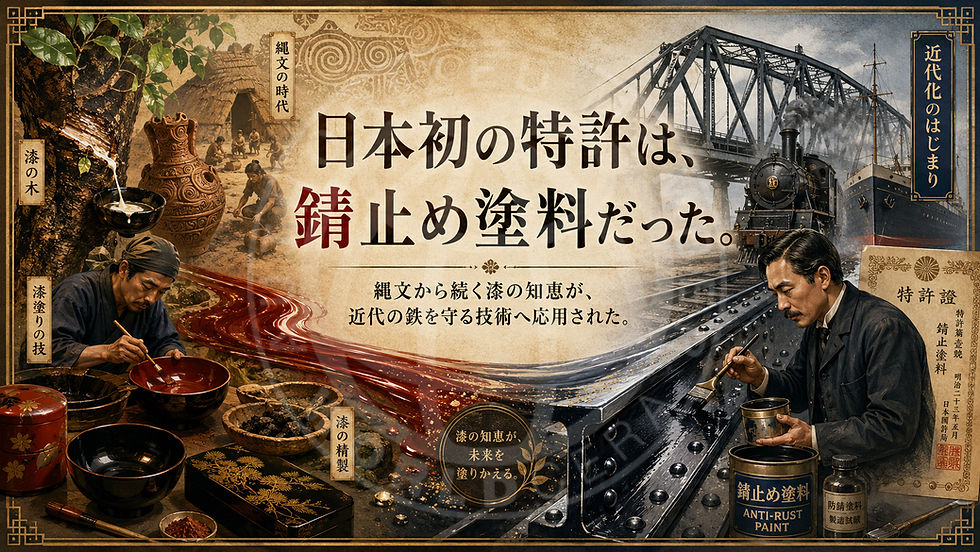
日本初の特許は、錆止め塗料だった
ここで、とても面白い出来事があります。
日本の特許第1号は、塗料に関する発明でした。
1885年、堀田瑞松による「堀田錆止塗料及ビ其塗法」が、日本の特許第1号として認められます。
この塗料は、漆を主成分とした錆止め塗料でした。
鉄製や鋼製の艦体、橋梁、機械器具などの錆を防ぐための塗料です。
ここが非常に面白いところです。
前回のテーマだった漆が、ここで再び出てきます。
縄文時代から使われてきた漆。器や木を守り、艶を出し、接着にも使われた天然素材。
その漆が、近代になると、鉄を錆から守る塗料として応用されていくのです。
つまり、近代化の中でも、伝統素材の知恵は完全に消えたわけではありません。
自然素材の知恵と、近代産業の課題が結びついた例が、日本初の特許だったとも言えます。
木を守る時代から、鉄を守る時代へ
前回の自然素材の時代では、主に木、土器、紙、布、工芸品を守る話が中心でした。
しかし、明治以降の近代化では、守る対象が変わっていきます。
木を守る。器を守る。紙や布を守る。
そこから、
鉄を守る。船を守る。橋を守る。工場を守る。建築を守る。
という時代に入っていきます。
ここで必要になるのが、防錆、防汚、耐水、耐候といった機能です。
塗料は、見た目を美しくするだけでなく、近代社会のインフラを守る材料になります。
つまり、塗料は「装飾の材料」から「産業を支える機能材料」へと進化していくのです。
船底塗料という高機能塗料への挑戦
近代塗料の発展の中で、船底塗料も重要なテーマです。
船底は、常に海水にさらされます。
錆びる。汚れる。貝や海藻などが付着する。船の速度が落ちる。燃料の効率が悪くなる。
そのため、船底塗料には、防錆、防汚、耐水性といった特殊な性能が求められました。
日本ペイントホールディングスの歴史資料では、1912年に船底塗料の国産化に成功したことが紹介されています。
ここで、塗料はさらに進化します。
ただ塗るだけではなく、海の環境に耐える。鉄を錆から守る。船の性能を支える。産業と物流を支える。
塗料は、社会の近代化とともに、より高度な機能を求められるようになっていったのです。
自然素材の知恵から、近代工業の技術へ
ここまで見てくると、塗料の歴史には大きな流れが見えてきます。
最初は、自然の中にあるものを見つけて使う時代でした。
木の汁が固まる。赤い石が色を出す。米がくっつく。海藻がとろみを出す。渋柿が紙や布を強くする。
そこから、開国によって洋式ペイントが入りました。
油と顔料を練る。洋館に塗る。船や鉄を守る。輸入品を使う。やがて国産化する。
そして、塗料は日本の近代化を支える材料になっていきます。
ここには、単なる材料の変化だけではありません。
守る対象が変わりました。使う場所が変わりました。必要とされる性能が変わりました。製造の仕組みも変わりました。
自然素材を使う知恵から、工業的に塗料をつくる技術へ。
これが、明治以降の大きな転換でした。
まとめ
日本の塗料は、開国とともに近代化した
日本には、古くから漆や柿渋、天然顔料による塗る文化がありました。
しかし、現在の意味での塗料、つまり洋式ペイントや近代塗料工業は、明治以降の開国とともに大きく発展していきます。
黒船来航。開国。洋館建築。輸入ペンキ。堅練り塗料。亜鉛華。光明社。国産塗料。錆止め塗料。船底塗料。
これらはすべて、日本が近代化していく中で必要とされた技術でした。
塗料は、ただ色をつけるものではありません。
建物を守る。船を守る。鉄を守る。社会インフラを守る。産業の発展を支える。
明治以降、塗料は日本の近代化を支える重要な材料になっていきました。
そしてこの流れは、やがて油性塗料から合成樹脂塗料へ、さらにアクリル、ウレタン、シリコン、フッ素、無機塗料へとつながっていきます。
自然素材の塗る文化から、近代の洋式ペイントへ。
ここから、日本の塗料は本格的に工業製品として進化していくのです。
参考リンク
本覚寺公式ページ「横浜開港とアメリカ領事館とペンキ跡」https://www.hongakuzenji.jp/history02.html
日本化学会「近代日本における塗料工業の発祥」https://www.chemistry.or.jp/know/isan032_article.pdf
日本化学会「第6回化学遺産認定」https://www.chemistry.or.jp/know/heritage/6.html
日本ペイントホールディングス「145年の歴史 Vol.1」https://www.nipponpaint-holdings.com/company/145th/history_01/
日本加工塗料「日本の特許第一号について」https://www.nippon-kako.co.jp/patent.html
日本ペイントホールディングス「年表で見る日本ペイントグループの歩み」https://www.nipponpaint-holdings.com/company/145th/timeline/
#塗料の歴史 #洋式ペイント #ペンキの歴史 #黒船来航 #ペリー来航 #開国 #横浜開港 #本覚寺 #明治時代 #光明社 #日本ペイント #国産塗料 #亜鉛華 #堅練り塗料 #錆止め塗料 #船底塗料 #外壁塗装 #塗料選び #日本の近代化
From a Culture of Painting with Natural Materials to Modern Western Paint
Black Ships, Western-Style Buildings, Imported Paint, and Japan’s First Domestically Produced Paint
In the previous article, we looked at Japan’s “culture of painting,” beginning with lacquer in the Jomon period.
Urushi lacquer.Bengara red iron oxide.Vermilion.Animal glue.Rice paste.Funori seaweed glue.Persimmon tannin.
Long before synthetic resin paints were created, people discovered materials in nature that could stick, harden, produce color, or resist water, and they learned how to use them in everyday life.
These materials were not only techniques for protecting tools and objects. They also became part of a culture of beauty and decoration.
Then, history began to move dramatically.
At the end of the Edo period, the Black Ships arrived in Japan.
With the opening of the country, new architecture, new culture, and new materials entered Japan from overseas.
One of those materials was Western-style paint, commonly called “penki” in Japanese.

The Arrival of the Black Ships and the Beginning of Western Paint in Japan
At the end of the Edo period, Japan entered a major turning point.
In 1853, the Black Ships led by Matthew Perry arrived in Japan.
Then, in 1858, the Treaty of Amity and Commerce between the United States and Japan was signed. In treaty ports such as Yokohama, foreign consulates and Western-style buildings began to appear.
As part of this movement toward opening the country, one of the things that entered Japan in earnest was Western-style painting.
Hongakuji Temple, located in Kanagawa Ward, Yokohama, was used as the American Consulate during the port-opening period.
According to official materials from Hongakuji Temple, consular staff at the time used Western painting methods, which did not yet exist in Japan, to paint parts of the building, including decorative carvings, with what was called penki.
In other words, modern paint application in Japan was deeply connected with the opening of the country, foreign consulates, and the Western-style culture of Yokohama.
Until then, Japan already had a culture of painting using materials such as lacquer, persimmon tannin, animal glue, and natural pigments.
However, the paint used on Western-style buildings and in foreign settlements was a new painting technology for Japan.
From a culture of finishing wood with lacquer to a culture of painting Western-style buildings and consulates with paint.
At this point, Japan’s painting technology reached a major turning point.
What Was Western-Style Paint?
Western-style paint at that time was different from today’s water-based paints and synthetic resin paints.
Its basic components were oil and pigment.
In modern terms, the oil acted like a binder or vehicle, while the pigment provided color.
In particular, pigments kneaded with oil into a thick paste were known as paste paint.
This was somewhat different from modern ready-mixed paint that can be used directly after opening the can.
It was more like a high-concentration mixture of pigment and oil that had to be adjusted with oil or other materials before application.
In the earlier age of natural materials, lacquer played a role similar to a natural resin, while bengara and vermilion acted like pigments.
In Western-style paint, oil functioned as the vehicle or binder, while pigment served as the color-providing material.
Although the materials changed, the basic idea remained the same.
Something that gives color.Something that fixes it to the surface.Something that protects the surface.Something that makes it beautiful.
This combination is the foundation of paint.
Why Did Japan Need Western-Style Paint?
Why did Japan need Western-style paint?
The answer is that society itself was changing.
With the opening of the country, Western-style architecture entered Japan.Foreign settlements were established.Western-style buildings were constructed.Modern infrastructure such as railways, ships, bridges, factories, and military facilities began to develop.
It was no longer only traditional wooden buildings and crafts that needed protection. Japan also needed to protect Western-style buildings and iron structures.
Ships and iron products became especially important.
Paint was no longer only for protecting wood. It now had to protect iron from rust.
It was no longer only for making buildings beautiful. It had to help modern infrastructure last longer.
At this point, the role of paint changed greatly.
Paint became not just a material for color and decoration, but a material that supported modern industry.
From Imported Paint to Domestic Paint
At first, Japan relied on imported Western-style paint.
Paint brought in from overseas was used on Western-style buildings, ships, and modern architecture.
However, as modernization progressed, demand for paint increased.
More Western-style buildings were built.More ships were needed.Railways expanded.Bridges were constructed.Factories were built.
As this happened, Japan could no longer rely forever on imports.
Japan needed to produce Western-style paint domestically.
This is where Shigejiro Mogi appears in the history of Japanese paint.
According to the Chemical Society of Japan’s Chemical Heritage materials, “The Origin of the Paint Industry in Modern Japan,” Shigejiro Mogi established a manufacturing method for zinc white in 1878. In 1879, he became the first in Japan to successfully produce domestically made paste paint, a form of Western-style paint.
Then, in 1881, Komyosha, the predecessor of Nippon Paint, was established.
From this point, Japan’s modern paint industry truly began.
Zinc White and the Importance of White Pigment
When considering the domestic production of modern paint, zinc white is an important material.
Zinc white is a white pigment whose main component is zinc oxide.
To make white paint, a white pigment is necessary.
At the time, there were also poisoning issues related to lead used in white face powder and other products. Because of this, zinc white had great significance as a white material.
In other words, domestic paint production was not simply about “making color.”
It involved technology for making pigments.Technology for mixing them with oil.Technology for kneading them.Technology for manufacturing products with stable quality.Technology for supplying materials needed by society.
These elements came together to form Japan’s modern paint industry.
In the previous article, bengara and vermilion were examples of natural pigments taken from nature.
In modern paint, however, it became important to manufacture pigments industrially and supply them consistently.
Here, too, we can see a major shift in the times.
From pigments found in nature to pigments produced industrially.
This was a major step forward in the history of paint.
Japan’s First Domestically Produced Western-Style Paint and Komyosha
Komyosha, established in 1881, is regarded as the starting point of Japan’s modern paint industry.
Komyosha later became connected to today’s Nippon Paint Holdings.
The Chemical Society of Japan’s Sixth Chemical Heritage Certification also explains that although Japan had long possessed paints represented by lacquer and persimmon tannin, most of what we now call “paint” today refers to Western-style paints that developed after the Meiji period.
In other words, the history of paint in Japan has two major streams.
One is the traditional culture of painting using lacquer and natural pigments.
The other is the stream of Western-style paint and the modern paint industry that began after the Meiji period.
As these two streams overlapped, Japan’s paint technology continued to develop.
Japan’s First Patent Was an Anti-Rust Paint
Here, there is a very interesting event.
Japan’s first patent was an invention related to paint.
In 1885, “Hotta Anti-Rust Paint and Its Application Method” by Zuisho Hotta was approved as Japan’s Patent No. 1.
This paint was an anti-rust paint whose main component was lacquer.
It was developed to prevent rust on iron and steel ship hulls, bridges, machinery, and tools.
This is an especially interesting point.
Lacquer, which was the theme of the previous article, appears once again here.
Lacquer had been used since the Jomon period.It protected vessels and wood, produced a beautiful gloss, and was also used as an adhesive.
In the modern era, that same lacquer was applied as a paint to protect iron from rust.
In other words, even during modernization, the wisdom of traditional natural materials did not completely disappear.
Japan’s first patent can be seen as an example of how the wisdom of natural materials and the challenges of modern industry came together.
From Protecting Wood to Protecting Iron
In the previous age of natural materials, the main focus was protecting wood, pottery, paper, cloth, and craft objects.
However, after the Meiji period, modernization changed the objects that needed protection.
Protecting wood.Protecting vessels.Protecting paper and cloth.
From there, Japan entered an era of:
Protecting iron.Protecting ships.Protecting bridges.Protecting factories.Protecting buildings.
This required functions such as rust prevention, fouling prevention, water resistance, and weather resistance.
Paint became more than a material for making things look beautiful. It became a material that protected the infrastructure of modern society.
In other words, paint evolved from a decorative material into a functional material that supported industry.
The Challenge of High-Performance Marine Paint
In the development of modern paint, marine bottom paint was also an important theme.
The bottom of a ship is constantly exposed to seawater.
It rusts.It becomes dirty.Shellfish, seaweed, and other organisms attach to it.The ship’s speed decreases.Fuel efficiency worsens.
For this reason, marine bottom paint required special performance, including rust prevention, fouling prevention, and water resistance.
According to historical materials from Nippon Paint Holdings, Japan succeeded in the domestic production of marine bottom paint in 1912.
At this stage, paint evolved even further.
It was no longer simply something to apply to a surface.It had to withstand the marine environment.It had to protect iron from rust.It had to support the performance of ships.It had to support industry and logistics.
As society modernized, paint was required to provide increasingly advanced functions.
From the Wisdom of Natural Materials to the Technology of Modern Industry
Looking back at this history, we can see a major flow in the development of paint.
At first, people used what they found in nature.
Tree sap hardened.Red stones produced color.Rice created adhesion.Seaweed produced viscosity.Persimmon tannin strengthened paper and cloth.
Then, with the opening of the country, Western-style paint entered Japan.
Oil and pigment were kneaded together.Paint was applied to Western-style buildings.Ships and iron were protected.Imported products were used.Eventually, domestic production began.
Paint became a material that supported Japan’s modernization.
This was not just a change in materials.
The objects being protected changed.The places where paint was used changed.The required performance changed.The manufacturing system also changed.
From the wisdom of using natural materials to the technology of producing paint industrially.
This was the major transformation that took place after the Meiji period.
Conclusion
Japan’s Paint Industry Modernized Alongside the Opening of the Country
Japan has long had a culture of painting with lacquer, persimmon tannin, and natural pigments.
However, paint in the modern sense — Western-style paint and the modern paint industry — developed greatly after the opening of the country in the Meiji period.
The arrival of the Black Ships.The opening of Japan.Western-style architecture.Imported paint.Paste paint.Zinc white.Komyosha.Domestically produced paint.Anti-rust paint.Marine bottom paint.
All of these were technologies required as Japan modernized.
Paint is not simply something that adds color.
It protects buildings.It protects ships.It protects iron.It protects social infrastructure.It supports industrial development.
After the Meiji period, paint became an important material supporting Japan’s modernization.
This flow would later continue from oil-based paints to synthetic resin paints, and then to acrylic, urethane, silicone, fluoropolymer, and inorganic paints.
From a culture of painting with natural materials to modern Western paint.
From this point onward, Japanese paint began to evolve fully as an industrial product.
Reference Links
Hongakuji Temple Official Website: “Yokohama Port Opening, the American Consulate, and Traces of Paint”https://www.hongakuzenji.jp/history02.html
The Chemical Society of Japan: “The Origin of the Paint Industry in Modern Japan”https://www.chemistry.or.jp/know/isan032_article.pdf
The Chemical Society of Japan: “Sixth Chemical Heritage Certification”https://www.chemistry.or.jp/know/heritage/6.html
Nippon Paint Holdings: “145 Years of History, Vol. 1”https://www.nipponpaint-holdings.com/company/145th/history_01/
Nippon Kako Toryo: “About Japan’s First Patent”https://www.nippon-kako.co.jp/patent.html
Nippon Paint Holdings: “The History of the Nippon Paint Group in Timeline Form”https://www.nipponpaint-holdings.com/company/145th/timeline/
#HistoryOfPaint #WesternStylePaint #HistoryOfPenki #BlackShips #PerryExpedition #OpeningOfJapan #YokohamaPortOpening #HongakujiTemple #MeijiPeriod #Komyosha #NipponPaint #DomesticPaintProduction #ZincWhite #PastePaint #AntiRustPaint #MarineBottomPaint #ExteriorPainting #PaintSelection #ModernizationOfJapan


コメント